

How Much Money Will It Take To Meet Paris Targets
Twelve years ago, at a United Nations climate summit in Copenhagen, rich nations made a significant pledge. They promised to channel US$100 billion a yr to less wealthy nations by 2020, to aid them conform to climatic change and mitigate farther rises in temperature.
That promise was cleaved. Figures for 2020 are not nevertheless in, and those who negotiated the pledge don't agree on bookkeeping methods, but a written report last year for the UN1 concluded that "the only realistic scenarios" showed the $100-billion target was out of reach. "Nosotros are not there yet," conceded Un secretarial assistant-general António Guterres.
Frustrations at this failure are contributing to rising tensions ahead of next month's crucial COP26 climate summit in Glasgow, UK. "By the time we get to Glasgow, if they haven't given us some other $100 billion [for 2021], then they are completely unable to meet their obligations," says Saleemul Huq, director of the International Middle for Climate Modify and Development in Dhaka.
Compared with the investment required to avoid dangerous levels of climate change, the $100-billion pledge is minuscule. Trillions of dollars will be needed each year to meet the 2015 Paris agreement goal of restricting global warming to "well below" 2 °C, if not ane.v °C, above pre-industrial temperatures. And developing nations (as they are termed in the Copenhagen pledge) will need hundreds of billions of dollars annually to adapt to the warming that is already inevitable. "Just the $100 billion is iconic in terms of the proficient faith of the countries that promised information technology," Huq says.
A flurry of pledges merely earlier the Glasgow meeting have led to hopes that, by 2022, rich nations volition manage to transfer $100 billion annually. But negotiators are already looking farther ahead: at COP26, discussions volition begin on a new climate-finance pledge for the mid-2020s. Nature lays out how the $100-billion pledge failed, which countries are most to arraign — and how climate finance might be transformed in the future.
How desperately did rich countries fall short?
Negotiators never agreed on precisely how to measure countries' pledges. The Organisation for Economic Co-operation and Development (OECD), an intergovernmental body made up generally of rich countries, bases its cess on reports from the wealthy nations themselves. They contributed $80 billion in climate finance to developing countries in 2019, it announced in September2, up from $78 billion in 2018. Most of this money came from public grants or loans, transferred either from ane state to some other straight, or through funds from multilateral development banks (MDBs). A smaller amount is individual finance that the public coin is said to have mobilized, such as loan guarantees and loans given aslope public funds (encounter 'Missed target').

Source: Ref. two
The figures are unlikely to have risen much in 2020: a June 2021 report from MDBs3 suggests that the climate finance they provided to developing countries barbarous concluding year. "Information technology isn't a corking sign," says Joe Thwaites, who specializes in climate finance at the World Resources Found (WRI) in Washington DC. International climate finance has probably stalled, he says, in function owing to the COVID-19 pandemic.
But some analysts say the OECD's numbers are vastly inflated. In a 2020 studyfour, the international-aid charity Oxfam estimated public climate financing at simply $19 billion–$22.5 billion in 2017–18, around one-third of the OECD'southward estimate (run across 'Inflated figures?'). That is largely because Oxfam argues that, besides grants, only the benefit accrued from lending at below-market rates should exist counted, not the full value of loans. Information technology besides says that some countries incorrectly count development help as going towards climate projects. Japan, for case, treats the total value of some help projects as 'climate relevant' even when they don't exclusively target climate action, says Tracy Carty, a senior policy adviser on climate change at Oxfam. Every bit some other example, some road structure projects are reported equally climate aid, with most or all of their costs included in OECD estimates, says Romain Weikmans, a climate-finance specialist at the Finnish Institute of International Diplomacy in Helsinki.

Sources: Refs ii & 4
Many low- and middle-income countries hold with Oxfam, and some get farther: in 2015, India's ministry of finance disputed the OECD's estimate of $62 billion of climate finance in 2014, saying that the existent effigy was $1 billion. Diann Black-Layne, Antigua and Barbuda's climate-change administrator and formerly the lead climate negotiator for a group of depression-lying littoral and island nations called the Brotherhood of Small Island States, says rich nations have intentionally inflated their climate aid.
Who is non paying enough?
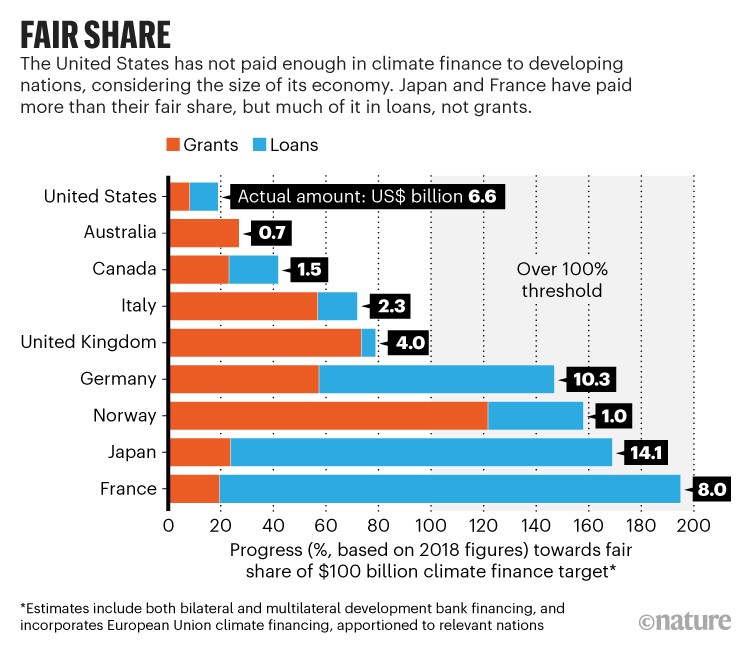
Although rich nations collectively agreed to the $100-billion goal, they made no formal deal on what each should pay. Instead, countries announce pledges in the hope that others volition follow. Multiple analyses of a notional fair share for these payments reach the same conclusion: the United States has fallen far short.
An Oct written report from the WRIv reckoned that the Usa should contribute 40–47% of the $100 billion, depending on whether the calculation takes into business relationship wealth, past emissions or population. But its average annual contribution from 2016 to 2018 was only effectually $seven.vi billion, the WRI estimates. Australia, Canada and Greece likewise fell far curt of what they should have contributed. Japan and French republic, on the other mitt, accept transferred more than their fair share — although almost all of their funding came in the form of repayable loans, non grants (see 'Off-white share').
Source: Ref. v
Where has the money gone?
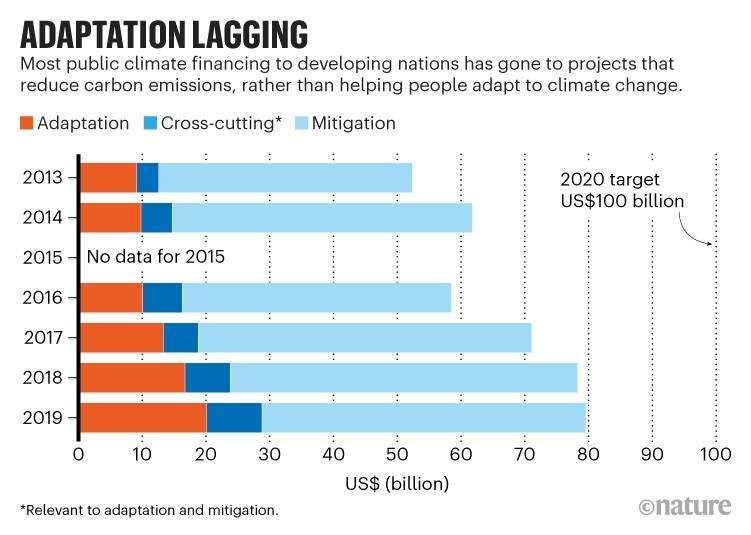
About of the climate finance has gone to projects to reduce greenhouse-gas emissions. The Paris agreement aimed for a balance between these 'mitigation' projects and those that help people adapt to the effects of climate change. Just just $20 billion went to accommodation projects in 2019, less than one-half of the funds for mitigation projects, the OECD found2 (see 'Adaptation lagging'). The Un estimateshalf-dozen that developing countries already need $lxx billion per yr to cover adaptation costs, and will demand $140 billion–$300 billion in 2030.
Source: Ref. 2
Donors might favour mitigation projects because success is clear and measurable — it tin exist quantified by the avoided or captured carbon emissions — whereas it's less easy to define successful accommodation, says climate-finance researcher Jessica Omukuti at the University of Oxford, Britain, who works on equitable ways for the world to reach cyberspace zilch carbon emissions. "A person or grouping is never fully adapted to climate change, because new climate risks and vulnerabilities emerge," she says. Politicians in developed countries too perceive that they get more praise from other nations, and from domestic voters, for spending to reduce emissions, she adds, whereas accommodation assistance is seen equally just helping specific recipient countries.
Another reason for the imbalance between mitigation and adaptation is that money is increasingly provided equally loans rather than grants. "Adaptation almost never is a loan-giving situation," says Huq. "If you're giving poor people coin to help them deal with the impacts of climatic change, that doesn't generate money." Private finance, in detail, most always seems to get to mitigation projects that can generate returns on investment, such as solar farms and electric cars.
Nearly of the climate finance is too going to middle-income countries, not the poorest, well-nigh-vulnerable countries. "Many, many African countries are lamenting that they are not able to spring through the hoops [to access climate finance] because of the complexity and the technicality," says Chukwumerije Okereke, an economist at Alex-Ekwueme Federal University Ndufu-Alike in Ikwo, Nigeria. "And they're not receiving sufficient capacity-building exercises and grooming in this."
Even the money that does go to the neediest countries might not exist reaching its target. In July, the International Plant for Environment and Development in London reported that information technology had tried to rail funding for adaptation projects in the United nations'southward 46 'least adult countries', and could business relationship for only $v.9 billion betwixt 2014 and 2018, less than 20% of the amount adult countries said they had given. "How much actually goes to the nigh vulnerable people on the planet?" asks Huq.
What do developing countries want at present?
The $100 billion pledge has long been seen as a minimum, to increase over fourth dimension. But some recipient countries take said they are willing to accept a static target for at present, if wealthy countries clearly set out how it will exist met.
"The need at the moment is since yous failed to deliver the $100 billion in 2020, requite the states a plan for $500 billion over five years," says Huq. In July, the 'V20', a grouping of finance ministers from 48 climate-vulnerable countries, called for that plan, including more grant-based finance, and at to the lowest degree 50% of funding to go to adaptation. Huq notes that countries are allocating their own budgets to climatic change, also. Bangladesh's government, for instance, says its climate-related spending totals about $three billion: that'southward some 7% of the government'due south overall budget, or 0.73% of the country's gross domestic product (Gross domestic product). And poor families in rural Bangladesh spend $2 billion a year themselves on preventing climate-related disasters or repairing the harm they cause, notes an Oxfam analysis (see go.nature.com/2yuycvn).

A woman stands among the debris of her house damaged by cyclone Amphan in Satkhira, People's republic of bangladesh, in May 2020. The cyclone, the strongest in the surface area in decades, was fuelled past sea-surface heating intensified past climate change. Credit: Munir Uz Zaman/AFP/Getty
New pledges have been pouring in: Canada, Japan and Deutschland announced theirs at a coming together of the G7 grouping of wealthy nations in June, at which countries likewise reaffirmed their delivery to contribute $100 billion annually through to 2025. In September, the European Marriage pledged an extra $5 billion past 2027, and U.s.a. President Joe Biden promised that the U.s.a. would provide $11.four billion in annual financing by 2024, which would make it the largest single climate-finance contributor. But much of that funding requires US Congressional blessing, and many other countries volition be contributing much more every bit a proportion of their economy. "The EU and its member states are already providing roughly double the amount the US has pledged, even with a combined economic system but three-quarters the size of America's," says Thwaites.
The question remains of whether rich nations tin convince less wealthy ones that they are serious about meeting their pledges. Some people debate that promises should exclude private finance, to avoid confusion. All the same, the actress pledges should enable wealthy nations to achieve the $100 billion target for 2022, according to climate economist Nicholas Stern at the London Schoolhouse of Economics.
Some governments are addressing the call for more accommodation funding. In August, Kingdom of denmark said information technology would allocate threescore% of its climate finance to adaptation, and other countries, including the Netherlands and the Great britain, take committed to ramping up adaptation finance.
At COP26, formal negotiations will as well begin on a post-2025 goal. A specific climate-finance target is unlikely to be set this year, although in July, Due south African environment minister Barbara Creecy suggested a figure of $750 billion a year by 2030. Many countries also desire extra finance for 'loss and impairment', to help people experiencing irreversible climate-related losses that cannot exist adapted to.
How much climate finance is enough?
Increasingly, the concept of climate finance is becoming redundant, Huq argues. "Every dollar spent is climate money spent," he says. "You lot either spend information technology wisely or you spend it unwisely."
However, the Climate Policy Initiative (CPI), a non-profit research group based in San Francisco, California, estimatesvii that flows of climate-related finance in and between countries amounted to $632 billion per yr in 2019–20, or about 0.7% of the world'south Gross domestic product. Around half of this was private funding, much of it for renewable-energy generation (see 'The climate-finance universe').

Source: Ref. seven
That is far below the UN Intergovernmental Panel on Climatic change'southward estimate that $i.6 trillion–$iii.8 trillion is required annually to avoid warming exceeding 1.v °C. Frustratingly, fossil fuels are nonetheless being subsidized, receiving some $554 billion per yr between 2017 and 2019, past one estimate. And in 2020, annual global military spending reached $ii trillion.
The CPI warns that the pandemic and its economic effects have put an accent on spending in areas such as public wellness (developed nations spent trillions terminal year to deal with the COVID-19 pandemic), making the mid-to-long-term prospects of climate finance uncertain. The real claiming now is how to ensure that the wider universe of private finance is spent on projects that address the issues of climatic change, says Sarah Colenbrander, director of the climate and sustainability programme at the Overseas Development Institute, a think tank based in London. "If we don't exercise that, nosotros are going to fail on climate even more catastrophically than nosotros've already done," she says.
Source: https://www.nature.com/articles/d41586-021-02846-3
Posted by: carpenterficholl90.blogspot.com
0 Response to "How Much Money Will It Take To Meet Paris Targets"
Post a Comment