

How To Find Standard Deviation With Mean And Sample Size
Standard Deviation Formulas
Divergence just means how far from the normal
Standard Deviation
The Standard Difference is a measure of how spread out numbers are.
You might similar to read this simpler folio on Standard Deviation start.
But here we explain the formulas.
The symbol for Standard Deviation is σ (the Greek alphabetic character sigma).
This is the formula for Standard Deviation:
![square root of [ (1/N) times Sigma i=1 to N of (xi - mu)^2 ]](https://www.mathsisfun.com/data/images/standard-deviation-formula.svg)
Say what? Please explain!
OK. Let us explain it step by stride.
Say we take a bunch of numbers similar 9, 2, 5, 4, 12, vii, 8, 11.
To summate the standard deviation of those numbers:
- i. Work out the Mean (the simple average of the numbers)
- 2. And so for each number: decrease the Mean and foursquare the result
- iii. Then work out the mean of those squared differences.
- 4. Take the foursquare root of that and we are washed!
The formula actually says all of that, and I will show y'all how.
The Formula Explained
First, let us accept some example values to work on:

Example: Sam has 20 Rose Bushes.
The number of flowers on each bush is
9, 2, 5, 4, 12, 7, eight, 11, 9, 3, 7, 4, 12, 5, 4, x, 9, 6, 9, 4
Piece of work out the Standard Deviation.
Step 1. Work out the mean
In the formula above μ (the greek letter "mu") is the mean of all our values ...
Example: 9, 2, five, iv, 12, seven, 8, eleven, 9, 3, 7, 4, 12, five, iv, 10, 9, 6, 9, 4
The mean is:
9+two+5+4+12+7+8+11+9+3+7+4+12+5+4+x+9+6+ix+4 xx
= 140 20 = seven
And and then μ = 7
Step 2. Then for each number: subtract the Hateful and square the consequence
This is the function of the formula that says:

So what is 10i ? They are the individual x values 9, 2, 5, iv, 12, 7, etc...
In other words x1 = 9, tentwo = 2, 10three = v, etc.
So it says "for each value, subtract the hateful and foursquare the effect", like this
Example (continued):
(9 - seven)two = (2)2 = 4
(2 - seven)2 = (-five)two = 25
(v - 7)2 = (-2)2 = 4
(4 - 7)two = (-iii)2 = 9
(12 - 7)2 = (five)ii = 25
(seven - seven)2 = (0)ii = 0
(8 - 7)ii = (one)two = 1
... etc ...
And nosotros get these results:
four, 25, iv, nine, 25, 0, 1, xvi, iv, 16, 0, 9, 25, 4, 9, 9, four, 1, iv, ix
Pace iii. Then work out the mean of those squared differences.
To work out the hateful, add together up all the values then split by how many.
First add up all the values from the previous step.
Simply how do we say "add them all upward" in mathematics? We utilize "Sigma": Σ
The handy Sigma Notation says to sum up equally many terms as we desire:
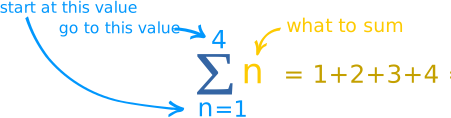
Sigma Notation
Nosotros want to add upwards all the values from ane to North, where N=20 in our case because there are twenty values:
Instance (continued):
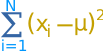
Which means: Sum all values from (xi-7)2 to (tenNorth-7)2
Nosotros already calculated (xane-7)2=4 etc. in the previous step, so merely sum them upwardly:
= 4+25+iv+9+25+0+ane+sixteen+4+16+0+9+25+4+9+9+four+1+four+9 = 178
Merely that isn't the hateful yet, we need to divide by how many, which is washed past multiplying by one/Northward (the same equally dividing past N):
Example (continued):
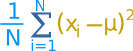
Hateful of squared differences = (ane/20) × 178 = 8.9
(Note: this value is called the "Variance")
Step 4. Have the square root of that:
Instance (concluded):
![square root of [ (1/N) times Sigma i=1 to N of (xi - mu)^2 ]](https://www.mathsisfun.com/data/../data/images/standard-deviation-formula.svg)
σ = √(8.9) = two.983...
DONE!
Sample Standard Deviation
But wait, in that location is more than ...
... sometimes our information is only a sample of the whole population.
Example: Sam has 20 rose bushes, just just counted the flowers on 6 of them!
The "population" is all xx rose bushes,
and the "sample" is the 6 bushes that Sam counted the flowers of.
Let united states of america say Sam'due south flower counts are:
nine, 2, 5, 4, 12, 7
We tin even so estimate the Standard Difference.
But when we utilise the sample as an estimate of the whole population, the Standard Deviation formula changes to this:
The formula for Sample Standard Deviation:
![square root of [ (1/(N-1)) times Sigma i=1 to N of (xi - xbar)^2 ]](https://www.mathsisfun.com/data/images/standard-deviation-sample.svg)
The important change is "N-1" instead of "Northward" (which is called "Bessel's correction").
The symbols also change to reflect that nosotros are working on a sample instead of the whole population:
- The mean is at present x (called "x-bar") for sample mean, instead of μ for the population mean,
- And the answer is south (for sample standard divergence) instead of σ.
Only they practise non bear upon the calculations. Only Northward-1 instead of N changes the calculations.
OK, let united states of america at present utilise the Sample Standard Departure:
Pace i. Work out the mean
Example 2: Using sampled values 9, 2, v, 4, 12, vii
The mean is (nine+2+5+4+12+7) / 6 = 39/6 = 6.5
Then:
x = six.v
Step 2. So for each number: decrease the Mean and foursquare the result
Case two (connected):
(9 - 6.five)2 = (2.5)2 = 6.25
(2 - 6.5)ii = (-iv.5)two = 20.25
(5 - vi.5)two = (-1.5)two = two.25
(4 - vi.5)ii = (-2.five)2 = half dozen.25
(12 - vi.5)2 = (5.5)2 = thirty.25
(vii - 6.5)ii = (0.5)two = 0.25
Step 3. Then piece of work out the hateful of those squared differences.
To work out the mean, add upwards all the values so carve up by how many.
But hang on ... we are calculating the Sample Standard Divergence, and then instead of dividing by how many (N), we will carve up by N-1
Instance ii (connected):
Sum = 6.25 + 20.25 + 2.25 + six.25 + thirty.25 + 0.25 = 65.five
Divide past N-ane: (1/v) × 65.five = 13.ane
(This value is called the "Sample Variance")
Step 4. Take the foursquare root of that:
Example 2 (ended):
due south = √(13.1) = 3.619...
Washed!
Comparing
Using the whole population we got: Hateful = vii, Standard Difference = 2.983...
Using the sample we got: Sample Mean = 6.5, Sample Standard Deviation = 3.619...
Our Sample Mean was wrong past 7%, and our Sample Standard Departure was wrong by 21%.
Why Take a Sample?
Mostly because it is easier and cheaper.
Imagine you want to know what the whole country thinks ... you tin can't ask millions of people, and then instead y'all enquire maybe one,000 people.
There is a overnice quote (possibly past Samuel Johnson):
"You don't have to eat the whole fauna to know that the meat is tough."
This is the essential idea of sampling. To find out information nearly the population (such as mean and standard deviation), nosotros do not need to look at all members of the population; nosotros merely demand a sample.
Just when nosotros take a sample, nosotros lose some accurateness.
Have a play with this at Normal Distribution Simulator.
Summary
| The Population Standard Departure: | | |
| The Sample Standard Difference: | |
699, 1472, 1473, 1474

How To Find Standard Deviation With Mean And Sample Size,
Source: https://www.mathsisfun.com/data/standard-deviation-formulas.html
Posted by: carpenterficholl90.blogspot.com
0 Response to "How To Find Standard Deviation With Mean And Sample Size"
Post a Comment